A technical comparison of all-electric and hydraulic tube bending machines covering precision, energy efficiency, maintenance, and total cost of ownership.
The tube bending industry is in the middle of a technology shift. All-electric servo-driven benders have matured to the point where they’re displacing hydraulic machines in many applications. But hydraulic benders aren’t going anywhere; they still dominate in certain use cases. Understanding the strengths and trade-offs of each technology helps you make the right investment for your operation.
How They Work
Hydraulic Tube Benders
Hydraulic benders use oil-filled cylinders powered by a hydraulic pump to generate bending force. The pump runs continuously during operation, pressurizing fluid that actuates the bend die, clamp die, pressure die, and mandrel. This is proven technology that has been the industry standard for decades.
All-Electric Tube Benders
All-electric benders replace the hydraulic system entirely with servo motors and ball screws (or similar mechanical actuators). Each axis of motion has its own dedicated servo motor, controlled by a CNC system that coordinates all movements precisely. There’s no hydraulic oil, no pump, and no valves.
Precision and Repeatability
Servo motors give all-electric machines a clear edge in precision, providing exact positional control typically within ±0.1° of bend angle. Each axis moves independently under closed-loop feedback, meaning the machine constantly monitors and corrects its position. Once a program is dialed in, the hundredth part comes out identical to the first.
Hydraulic systems are inherently less precise due to oil compressibility, seal wear, and temperature-dependent viscosity changes. As hydraulic oil heats up during a production run, its behavior changes slightly, which can introduce variation. Skilled operators compensate for this, but it requires attention and experience.
If your application demands tight bend tolerances (automotive components, aerospace tubing, medical devices, or furniture with visible seams), all-electric is the stronger choice. For structural applications where ±0.5° is acceptable, both technologies work fine.
Energy Efficiency
All-electric benders consume significantly less energy than hydraulic machines, typically 50-70% less. The difference comes down to how each system uses power. A servo motor only draws power when it’s actually moving, sitting idle between cycles. A hydraulic pump, by contrast, runs continuously to maintain system pressure, consuming energy whether or not the machine is actively bending.
Over a single shift, this difference might seem modest. Over a year of production, it adds up to thousands of dollars in energy savings. For shops running multiple benders across two or three shifts, the cumulative savings are substantial.
There’s also a secondary benefit: less heat generation. Hydraulic systems produce considerable waste heat, which in warm climates means additional air conditioning costs to keep the shop comfortable and maintain part quality.
Cycle Times
All-electric benders are generally faster, especially on complex multi-bend parts. Servo drives accelerate and decelerate rapidly, and multiple axes can move simultaneously. A complex part with 8-10 bends might cycle 20-30% faster on an electric machine compared to a hydraulic equivalent. On high-volume production runs, this adds up to hundreds or thousands of additional parts per week.
Hydraulic machines are limited by valve response times and the sequential nature of many hydraulic circuits. Higher-end hydraulic benders with proportional valves close the gap somewhat, but servo drives are inherently faster at axis transitions.
Maintenance and Uptime
Maintenance demands differ sharply between the two technologies, and this is one of the strongest arguments for going all-electric.
Hydraulic Maintenance Includes:
- Regular oil changes and filter replacements
- Seal inspection and replacement
- Hose inspection for wear and leaks
- Pump maintenance and eventual rebuild
- Managing oil disposal and environmental compliance
- Monitoring oil temperature and contamination
All-Electric Maintenance Includes:
- Periodic lubrication of ball screws and guides
- Servo motor and drive inspection (rare failures)
- Standard electrical component checks
All-electric machines simply have fewer components that wear out. No seals to leak, no oil to degrade, no filters to clog. This translates directly to higher uptime and lower maintenance costs.
The shop floor stays cleaner too. Hydraulic leaks are hard to avoid, since even well-maintained machines develop minor seepage over time. With an all-electric bender, the oil-free environment keeps the work area clean and eliminates slip hazards.
Bending Force and Material Range
Hydraulic benders have traditionally held the advantage for heavy-wall, large-diameter tubing. Hydraulic cylinders generate enormous force at relatively low cost, making them well-suited for bending thick-wall steel pipe or large structural sections.
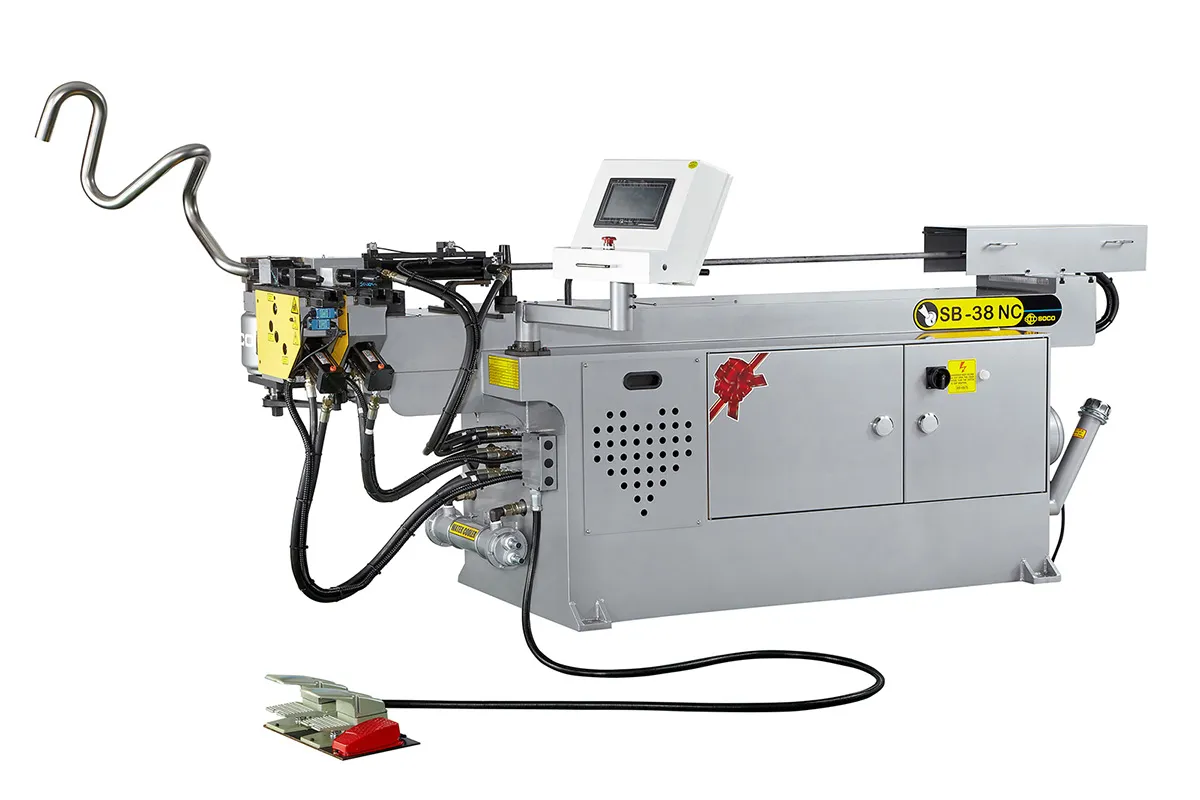
However, modern all-electric benders have steadily increased their force capacity. Today’s machines handle a wide range of tube sizes and wall thicknesses that cover the majority of production applications. The SOCO all-electric benders in our tube bending lineup are rated for a range of applications from thin-wall precision tubing to standard structural tube sizes.
Hydraulic still holds the edge for very large diameter, heavy-wall applications, roughly 4“+ OD with 0.25“+ wall thickness. If that describes your primary workload, hydraulic may remain the better fit.
For nearly everything else, all-electric comes out ahead, especially when precision, speed, and low maintenance matter.
Noise Levels
Hydraulic pumps generate constant background noise during operation, typically 75-85 dB depending on the machine and installation. This contributes to operator fatigue and may require hearing protection.
All-electric machines are significantly quieter, as the only noise comes from the mechanical motion of the bending process itself. Shops that have switched to all-electric machines frequently comment on the improved working environment.
Total Cost of Ownership
All-electric machines typically carry a higher purchase price than comparable hydraulic benders. However, the total cost of ownership over a 10-15 year machine life often favors all-electric:
| Cost Factor | Hydraulic | All-Electric |
|---|---|---|
| Purchase price | Lower | Higher |
| Energy costs | Higher | 50-70% lower |
| Maintenance costs | Higher (oil, seals, filters) | Lower |
| Downtime costs | More frequent maintenance | Less frequent |
| Part scrap rate | Higher (variation) | Lower (precision) |
| Floor cleanliness | Oil management needed | Clean operation |
For most production environments, the all-electric machine pays back its price premium within 2-4 years through reduced operating costs and higher productivity.
Making the Right Choice for Your Shop
All-electric is usually the right call when:
- Precision and repeatability are critical
- You’re running medium to high production volumes
- Energy costs are a concern
- You want to minimize maintenance burden
- Part complexity requires fast multi-axis movement
Hydraulic still makes more sense if:
- You’re bending very large, heavy-wall tubing
- Purchase budget is the primary constraint
- Your existing maintenance team has deep hydraulic expertise
- Bend precision requirements are moderate
Explore Your Options
We carry a full range of SOCO tube bending machines, including both all-electric and hybrid models. Our team can help you evaluate which technology makes the most sense for your specific application, production volume, and budget.
Ready to discuss your tube bending needs? Contact us for a consultation, or request a quote on a specific machine.