A practical guide to selecting the ideal cold saw based on material type, cutting capacity, production volume, and automation needs.
The cold saw you choose has a direct effect on your production efficiency. Whether you’re cutting mild steel bar stock or stainless tubing, the wrong machine leads to slow cycle times, poor cut quality, and premature blade wear. This guide walks you through the key factors to consider so you can match the right saw to your application.
What Is a Cold Saw?
Unlike abrasive cutoff saws that generate heat through friction, cold saws use a toothed circular blade rotating at controlled speeds. The blade transfers heat into the chip rather than the workpiece, producing clean, burr-free cuts with tight tolerances. This matters when downstream processes like welding or assembly depend on square, accurate cuts.
Factor 1: Material Type
Your material dictates blade speed, feed rate, and blade selection. The most common materials break down like this:
- Mild steel and carbon steel: The most forgiving material for cold saws. Standard HSS blades work well at moderate speeds, and most general-purpose cold saws handle these without issue.
- Stainless steel: Requires slower blade speeds and higher feed pressure. Look for machines with variable speed drives and rigid construction to prevent work hardening. Carbide-tipped blades are often worth the investment here.
- Aluminum: High blade speeds are essential to prevent material from welding to the teeth. Machines with speeds above 3,000 RPM and proper chip evacuation perform best.
- Structural shapes (angles, channels, beams): These need adequate clamping and a blade diameter large enough to handle the profile in a single pass.
If you regularly switch between materials, a variable-speed saw with a wide RPM range gives you the flexibility to optimize for each job.
Factor 2: Cutting Capacity
Cutting capacity is defined by the maximum round, square, and rectangular cross-sections a saw can handle. Consider both your current needs and anticipated growth:
- Bar stock and solid rounds: Measure the largest diameter you’ll cut regularly, then add 10-20% for occasional oversized work.
- Tubing and pipe: Wall thickness matters as much as OD. Thin-wall tubing cuts differently than heavy-wall pipe.
- Bundles: If you’re cutting multiple pieces per stroke, you need a machine rated for bundle cutting with appropriate clamping.
Bigger isn’t always better. An oversized machine wastes floor space and energy, while a properly sized saw runs more efficiently and produces better cuts.
Factor 3: Production Volume and Automation
Your daily throughput determines how much automation you need:
Manual Saws
Best for job shops and low-volume work. The operator positions and clamps the material, initiates the cut, then advances for the next piece. Simple, affordable, and versatile for mixed work.
Semi-Automatic Saws
The machine handles the cutting cycle automatically: the blade feeds down, makes the cut, and retracts. The operator still loads and positions material. These are the sweet spot for many shops, offering faster cycle times without the cost of full automation.
Fully Automatic Saws
Material feeding, measuring, clamping, cutting, and part ejection happen without operator intervention. If you’re running long production runs of repetitive cuts, a fully automatic saw pays for itself quickly through reduced labor costs and consistent output.
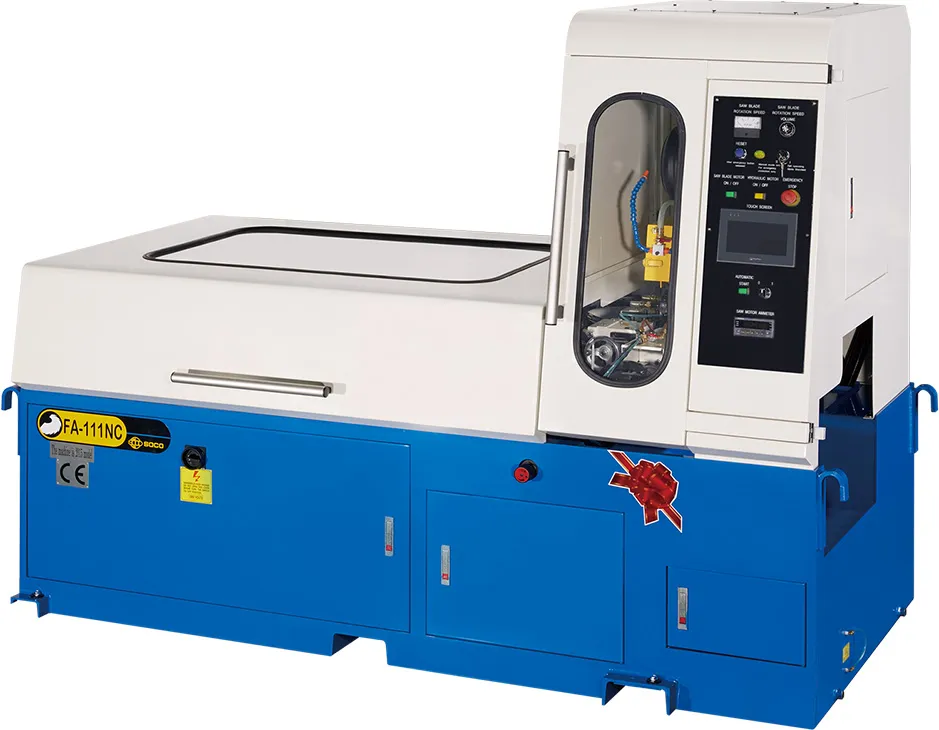
Our sawing machine lineup includes options at each automation level, from manual machines for versatile job shop work to fully automatic CNC saws for high-volume production.
Factor 4: Cut Quality Requirements
Not all applications demand the same finish:
- Parts going to welding: A standard cold saw cut is typically sufficient. The square, burr-free edge produces strong, consistent welds.
- Parts with visible surfaces: You may want a saw that produces a finer finish, reducing or eliminating secondary finishing operations.
- Precision assemblies: When tolerances matter, look for machines with rigid construction, precision bearings, and positive material clamping. Angular accuracy and length repeatability are key specs to compare.
Factor 5: Blade Life and Maintenance
Blade costs add up fast on high-volume operations. Consider:
- HSS blades can be resharpened multiple times, keeping per-cut costs low. Our blade resharpening service can extend the life of your HSS blades significantly.
- Carbide-tipped blades last longer between sharpenings and cut harder materials, but cost more upfront. We offer carbide blade services including retipping and resharpening.
- Coolant systems: Proper flood coolant extends blade life dramatically. Machines with built-in coolant systems should be standard for production work.
Making Your Decision
Work through it step by step:
- List your materials and sizes. Know what you’re cutting today and what you might cut in the next 3-5 years.
- Calculate your volume. How many cuts per shift? This determines your automation level.
- Define your quality needs. What tolerances and finish do downstream processes require?
- Consider your floor space. Measure the available area, including material handling on both sides of the saw.
- Factor in total cost of ownership. Purchase price is just the beginning. Blade costs, maintenance, energy consumption, and labor all contribute to your true cost per cut.
We Can Help
At World Machinery & Saw, we’ve been helping manufacturers select the right cutting equipment for decades. We carry a full range of circular cold saws from SOCO Machinery, covering everything from compact manual saws to fully automatic CNC systems.
Whether you’re replacing an aging machine or setting up a new production line, contact us to discuss your application. We’ll help you find the right match for your material, volume, and budget.