New to CNC tube bending? This guide covers how the machines work, key terminology, common bending methods, and what to consider when specifying bent tube parts.
CNC tube bending machines turn straight tubes into precisely shaped components used in everything from automotive exhaust systems to architectural handrails. If you’re new to the technology, whether you’re an engineer specifying bent parts, a shop owner evaluating equipment, or a new operator, this guide covers the fundamentals you need to understand.
How CNC Tube Bending Works
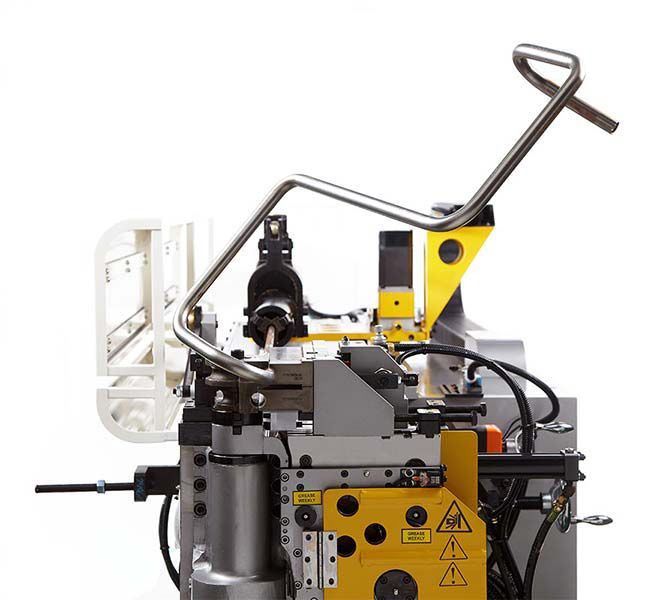
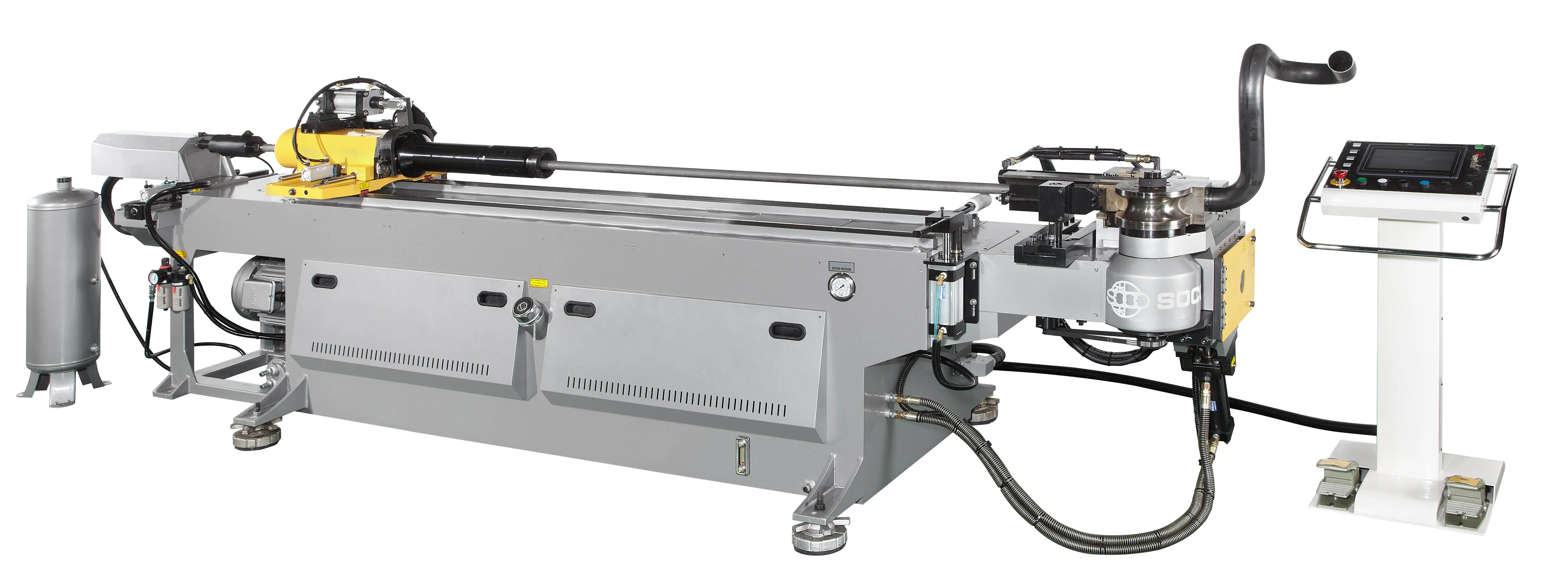
The basic idea is straightforward: a straight tube is clamped against a round die and pulled or pushed around it to form a curve. CNC bending adds precise control over every variable in that process, which is what makes it so capable.
A CNC tube bender typically controls these axes of motion:
- Bend axis (B): Rotates the bend die to form the bend angle. A 90-degree bend means the die rotates 90 degrees.
- Feed axis (Y): Advances the tube forward between bends to set the distance between bends (the straight length).
- Rotation axis (C): Rotates the tube around its own axis to set the plane of bend. This is how the machine creates 3D shapes, since each bend can be in a different plane.
By coordinating these three axes, a CNC bender can produce complex multi-bend parts with bends in multiple planes, all from a single program with no manual repositioning.
Key Terminology
Bend Radius (CLR)
This is the centerline radius, the distance from the center of the tube to the center of the bend curve. A tighter radius means a sharper bend. Most standard bending uses a CLR of 1.5 to 2 times the tube diameter. Going tighter than 1x the diameter requires special tooling and techniques.
Bend Angle
How far the tube is bent, measured in degrees. A 90-degree bend creates a right angle. A 180-degree bend creates a U-shape.
Springback
Metal is elastic, so it springs back slightly after bending. A tube bent to 90 degrees on the die might measure 88 degrees after release. CNC machines compensate for springback automatically by overbending a calculated amount. The springback percentage varies by material, wall thickness, and bend radius.
D of Bend
Bend radius expressed as a multiple of tube diameter. A 2-inch tube bent on a 3-inch CLR die is a 1.5D bend. Lower D values mean tighter bends. Standard bending is typically 1.5D to 3D. Below 1.5D is considered tight-radius bending and requires more sophisticated tooling.
Mandrel
A segmented steel insert placed inside the tube during bending to prevent the tube from collapsing or wrinkling on tight bends. Not all bends require a mandrel. Larger radius bends on thick-wall tubing often bend cleanly without one.
Wiper Die
A stationary die that sits behind the bend point to prevent wrinkles from forming on the inside of the bend. Used in conjunction with a mandrel for tight-radius bends on thin-wall tubing.
Pressure Die
Holds the straight portion of the tube against the bend die during bending. On advanced machines, the pressure die can also assist the bend by feeding forward, reducing the pulling force on the tube.
Bending Methods
Draw Bending
This is the most common method. The tube is clamped to the bend die, which rotates and draws the tube around itself. Draw bending produces precise, repeatable bends and works well for most applications. Nearly all CNC tube benders use draw bending.
Compression Bending
A simpler method where a roller pushes the tube around a stationary die. Less precise than draw bending and typically used for larger radius bends where high accuracy isn’t critical. Common in manual and low-cost benders.
Roll Bending
Three rollers arranged in a triangle progressively curve the tube through repeated passes. Used for large-radius sweeps and curves rather than defined-angle bends. Roll bending is a different category of machine from standard CNC benders.
What Affects Bend Quality
Material Properties
Different metals behave differently during bending:
- Mild steel: The most forgiving material. Bends predictably with consistent springback.
- Stainless steel: Higher springback, and it work-hardens during bending. Requires more force and careful tooling selection.
- Aluminum: Low springback but prone to cracking on tight bends, especially in harder alloys. Surface finish can be a concern.
- Copper and brass: Soft and easy to bend but can wrinkle without proper support.
Wall Thickness
Thinner walls are more prone to collapse, wrinkling, and ovalization during bending. The ratio of wall thickness to tube diameter determines how tight you can bend without internal support. As a general rule, thinner walls and tighter radii require mandrel bending.
Tube Tolerance
The bending process amplifies inconsistencies in the incoming tube. Variations in wall thickness, diameter, ovality, and material hardness all affect the final bent part. Starting with good-quality, consistent tubing is essential for holding tight tolerances on bent parts.
Choosing the Right Machine
When evaluating CNC tube benders, key specifications to compare include:
- Maximum tube size: The largest OD and wall thickness the machine handles.
- Number of bend axes: Basic machines handle one bend radius per setup. Multi-stack machines can switch between multiple radii in a single program.
- Bend capacity: Maximum bend angle per bend (typically 180-190 degrees).
- Feed length: Maximum tube length the machine can process.
- Drive type: All-electric vs. hydraulic is a significant decision affecting precision, maintenance, and operating costs.
- Control system: Programming interface, simulation capability, and data import options.
Our tube bending lineup includes SOCO CNC benders covering a range of tube sizes and configurations. Contact us to discuss which model fits your application requirements.
Getting Started
If you’re new to specifying bent tube parts, work with your bending supplier early in the design process. Small changes to bend radii, straight lengths between bends, or material selection can make the difference between a part that’s easy and affordable to produce and one that requires expensive tooling or isn’t feasible at all.
The more you understand about how the bending process works, the better your designs will be, and the more productive your conversations with equipment suppliers and fabricators will be.